Father Serra - Missionary

Father Serra - Missionary
Always forward, never back
Showing posts with label San Diego. Show all posts

Saturday, June 2, 2012

More of Fernando Rivera


Despite his love of the Jesuits who had made his career for him, Captain Rivera obeyed orders in a most professional manner. He helped gather the Jesuits and led them to the vessel they were to board for the voyage to San Blas – and then home to Spain. I can find no record of his thoughts, but Governor Portolá described the grief of the Indians at the loss of their padres – a feeling surely shared by Rivera.


His job then was to lead Portolá and the usurper Franciscans through the rugged Baja desert. Their first goal was a Cochimi village called Velicatá which he and Father Linck had discovered three years before. That was to be the site of the first – and only – Franciscan mission in Baja
 
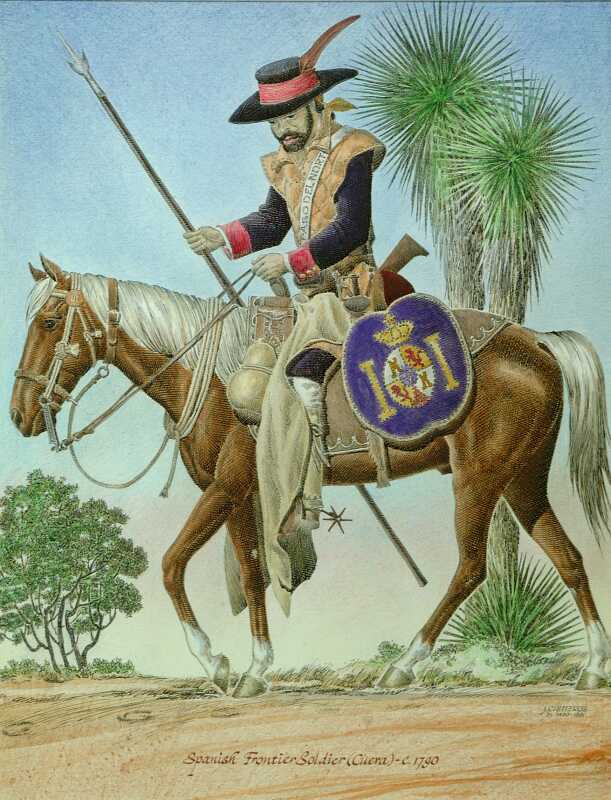
Rivera set off on this 700 plus mile trek with 25 of his own presidials [known as soldados de cuera or Leatherjackets] and 40 Indian neophytes recruited from Missions Santa Maria and San Borja. He was too break trail, establish camp sites, herd livestock, and generally prepare the way for Portolá's party. 
 
One other individual needs to be mentioned here, Sergeant Jose Ortega. This dauntless soldier led the way from Loreto to San Diego and then on to San Francisco. He and his scouts never hesitated, although sometimes sick and weak. He was often turned back but never gave up. The true hero behind los Caminos del Misiónes and el Camino Real is Ortega.

Rivera had been preparing for the expedition since the previous September 1768. He set off and reached Velicatá in December. But, his journey had barely started. Once Portolá, Serra, and the others arrived, Rivera and 25 soldados de cuera, Friar Juan Crespí, the masters mate, Jose Carizares, three muleteers, and a band of Christianized natives left Velicatá in March. This land division was termed the first division. They traveled for some 51 days and covered 121 leagues to San Diego. Food was short, and the neophytes were expected to forage for most of what they needed. Many neophytes died along the way...more deserted.


On May 15, 1769, Rivera and his party reached San Miguel Bay, the site of Misión San Diego.

Things had not gone so very well for the sea part of the expedition. Two ships lay in the harbor but their crews were ashore in a camp where they were sick and dying of scurvy and dysentery. The friars and the only Doctor, Don Soler, were taxed to the maximum. They cure to scurvy was known – simply provide lots of fresh fruits and vegetables to replace the lost Vitamin C. But the Spaniards were loath to eat any of the local foods, perhaps feeling they were tainted by the local savages. And, the local Indians were not all that friendly and had been giving the Spaniards a lot of problems so they weren't about to help. The Indians, not knowing the idea of ownership, wandered through the camp and picked up anything that took their fancy. That strained relations to the point of gunfire and even arrow fire.

As soon as Portolá and the others arrived, Rivera and his men were once more sent ahead to break way and establish a road for the others to follow in their search for the fabled Bay of Monte Rey.

Again, Rivera performed professionally. He and his soldiers carried out their duties and more while Lieutenant Fages [Rivera's superior remember!] followed along, many sick and all complaining of the harsh conditions and lack of “real” food. 


They missed Monte Rey on the way north and were still uncertain when they returned. Rivera and his men were sent through the very rugged terrain south from there along the coast while Fages and his Catalonian Volunteers got to rest.

They, at last make it back to San Diego in February 1770. Was Rivera or his men given a break? Not hardly. One ship had been sent to San Blas for supplies but had not returned. 
 
Portolá sent Rivera once more on a long trek, returning to Loreto to gather supplies and bring them back overland. While he was doing this, the packet boat San Antonio returned to San Diego with supplies. It then sailed north to establish the main fort [presidio] at Monte Rey.

When Portolá gave up the governorship, handing it over to Fages, Rivera knew he'd been messed over. He returned to San Diego and Loreto – where his wife and children lived – and sent a letter to the viceroy asking permission to retire on grounds of pains and bad health.

The viceroy gave his permission and Rivera returned to the mainland to live the leisurely life of a Spanish gentleman.


But, not for long.


Tuesday, April 17, 2012

The California Presidios


As indicated in previous posts, growing up in Southern California made me aware of its Spanish influence. I knew of the missions but had never heard of “presidios.” The first time I became aware of them was during my Basic Combat Training at Fort Ord, California. [See my earlier posts about military life.] The Special Services Office gave guided tours for we poor recruits – the only way we were permitted to leaved the base before graduation. On a tour to the famous Cannery Row, the guide briefly said something about “The Presidio,” a large, nearby, park-like area.

Then, I was assigned to the Presidio of San Francisco. I then learned that presidio meant a fort of some kind. If there was a museum there, I don't remember it so I don't think I ever delved into the history of the place. I just assumed it came from the Spanish era.

My research into the era for Father Serra's Legacy has taught me what they were and the important role they played in California history.

The above map shows the first presidio established in California located alongside the bay in San Diego. There is very little left of this place that never really reached a stage of building to truly defending against an attack from the sea. It started as a place where sick and dying Spanish soldiers were housed and from where the dead were taken to the nearby cemetary. Over the years, even though it had a reasonable number of soldados de cuera, the name for the soldiers who served in the area literally meaning soldiers of leather jackets, it was never fully manned.

Now that you're curious, these soldiers were lancers and the jackets they wore were of very thick layers of leather that could keep an arrow from inflicting wounds.

As of 1790, a census of the San Diego shows on lieutenant, commanding, one cadet, one sergeant, 5 corporals, and 88 common soldiers with their wives and children. Not exactly a whole lot after being in existence for 21 years!

 
The next presidio to be founded was at Monte Rey [the correct Spanish name of the place] supposed to be the capitol of Upper California. The capitol of both upper and lower California was in Loreto, Baja California that didn't have a presidio!

 
The above picture doesn't seem to be that accurate. It is supposedly from Captain Vancouver's diaries or journal and the location is wrong. First of all, the Monte Rey peninsula is forested with massive, tall pines. Second, the presidio was close to the bay as its purpose was to defend against a naval attack. The items in the picture DO seem to reflect what he would have seen.

Again, in spite of its supposed importance, the garrison never reached the size necessary to defend it. In fact, French pirates came and simply ignored the helpless soldiers, setting off to raid the nearby pueblo or village.

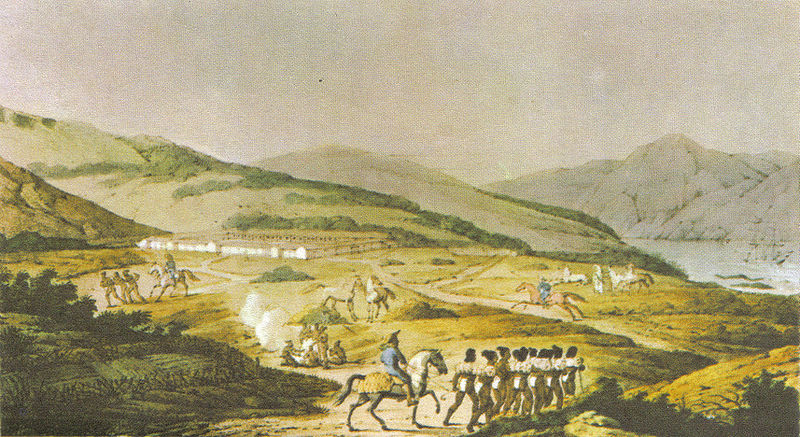
The next to be established was probably the most important in military terms, the Presidio of San Francisco defending the entrance to the huge bay.

 
Again, having lived there, this so-called “historical depiction” seems to be somewhat lacking in accuracy. The fort itself was much closer to the water with long cannon aimed out to sea. The soldiers are not wearing the proper uniforms and it insinuates the Miwok Indians were being herded around like slaves. Again, another example of “politically correct” propaganda about how badly the poor aborigines were treated.

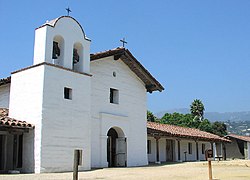
And finally, the fourth presidio, the one at Santa Bárbara. A little bit of reading lets one discover that the fort was actually built well before the mission – very much to Father Serra's disappointment.


Of all the presidios, this was probably the best built and manned. It was not meant to protect a big harbor as there really wasn't one. But, because of winds and currents, it was a regular land fall for Manila Galleons after their arduous voyages across the Pacific. Any ship landing there was well-received and crews were delighted with what the missions friars had to offer. Because of soil and climate, a wide variety of fruits and vegetables were cultivated. Bananas. Figs. Dates. And all of the regular fruits; apples, apricots, peaches, oranges, lemons, limes, etcetera. And fresh vegetables. When Vancouver landed there during one of his voyages, the friar from Mission San Buenaventura brought up a small flock of sheep for provisioning the two ships under his command.


Like all of the presidios – and missions – this fell into disrepair when Mexico gained its independence from Spain and took over California. The above picture was taken in 1880, well after the arrival of Americans and California's inclusion in the United States.
I'm posting it so you can see an example of a building made of adobe with the tile roof.

I hope you enjoy this and my other posts as much as I've enjoyed gathering the information. Until next time – and I have no idea what it will be about!